by John | Dec 15, 2017 | Featured Script of the Month, Highlights, Monthly Contest Winners, Our Winners, Updates, WMCm, WriteMovies News
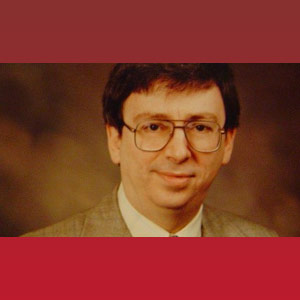
Featured Script of the Month for October/November – DEAD MAN’S HAND by Ronald L. Ecker
We chose Ronald’s script from a host of October and November submissions for its intriguing concept – which is what this free contest is all about! We combined the Script of the Month to include both October and November entries because of the off-period between our Summer Contest and current Winter 2018 Contest (enter here!) to give everyone the best opportunity possible.
For winning the Featured Script of the Month, Ronald now receives free Judging Feedback and publicity on our website, Twitter feed, and Facebook page. Ronald will also get the chance for a free resubmission of his script to our current main screenwriting contest! A great set of prizes for a free writing contest!
Here’s Ronald’s summary of this interesting script…
When the hypnotist dies during a past life regression, it leaves a present-day schoolteacher and an Old West gunfighter trapped in each other’s body and times.

Check out a short biography on Ronald, too!
Born and raised in Florida, Ronald L. Ecker received a B.A. in English at the University of Florida, and spent two years as a Peace Corps Volunteer in Arequipa, Peru. He earned a Master of Library Science degree at Florida State University, and worked as a librarian at Barry University in Miami and with the state of Florida until his retirement in 2000.
He is the author of five published books, including the Dictionary of Science and Creationism, selected by the review journal Choice as one of the Outstanding Academic Books of 1990. His complete modern-English translation of The Canterbury Tales (with Chaucer scholar Eugene J. Crook) was a widely adopted text in college and university literature courses, and is now available free in an online edition.
He also writes screenplays and songs. His scripts have been in the Winners category in four screenplay contests (e.g., 2nd Place Winner in the 2014/15 Comedy Screenplay Contest, and a Winner in the 2016 True Story Screenplay Competition) and finalists in 14 others.
Enter our Featured Script of the Month Contest with any contest entry or by purchasing any one of our top, studio-quality mentoring services.
by John | Dec 15, 2017 | Highlights, Industry News, Updates, WriteMovies News
So you want to be a screenwriter, huh? Well, we want you to be, too! For nearly 20 years we’ve been developing writers with our mentoring services and contests with the aim of getting writers’ scripts produced. And now we’re going that step further… our Hollywood Virtual Film School is here!
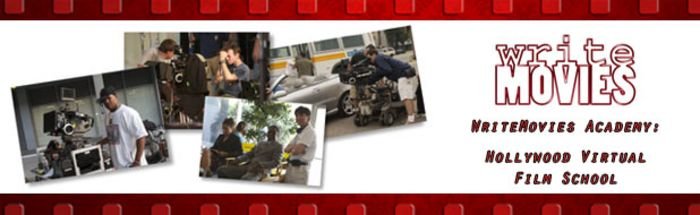
The WriteMovies Academy is introducing a brand new Hollywood Virtual Film School for all you aspiring writers and producers.
This 6 month academy will put you through your paces with courses on how to crystallize your concept, how to put that down into a script, and how to sell it and work with the production and distribution – all taught by our top, experienced script analysts, producers and writer mentors.
You invest months of your life on a script in the hope that it will sell. There is nothing sadder or more defeating than a script that has not sold. You owe to yourself to give your projects the best possible chance of getting made. We provide that to you. For a few cents for every hour of your life you have or are about to invest, we will provide you with not only a safety net, but a support system that will always be there for you. You cannot make it on your own, the odds are totally against you. Let us help you: THIS IS WHO WE ARE, PEOPLE WE HAVE HELPED, and FEEDBACK.
Don’t blow $100,000 to go to film school and be taught by “has beens”. We can teach you to become a professional screenwriter or writer-producer for $3000 and you will be taught by successful working professionals! Let us know about your own personal situation and WriteMovies will adopt a specific plan of action to take your script or idea to the next level.
Book your place on the first Phase of the course, or all six right here!
The Phases of the course, and their launch dates, and prices are shown below:
- Phase 0 (Project Selection, Additional consultation & notes): $250 (or free if you buy all of the Phases 1-6 for $3000!)
- Phase 1 (concept & development): $500
- Phase 2 (development & outlining): $500
- Phase 3 (1st draft & coverage):
$500
- Phase 4 (writing is rewriting & 2nd draft coverage): $500
- Phase 5 (pitching and promoting your script): $500
- Phase 6 (that’s a wrap): $500 per year for ongoing support
- Or, book your place on every Phase at once for just $3000, which includes Phase 0 absolutely free!
For more info on each Phase just click here, or to book your place for Phase 1, go right HERE.
by John | Dec 11, 2017 | Ian Kennedy, Writing Insights
In previous articles, we’ve seen how even visionary pictures of the distant future can look outdated within a generation. But writing the near future is actually far riskier, as this article will explore…

So, for every fine sci-fi story that gets caught on the wrong side of the future, there are much worse movies and series that can’t even present the present accurately. The original KNIGHT RIDER (1982-86) and its various spin-offs were predicated on intuitive artificial intelligence – yep, even in 1982. It was a very fun dream, in tune with the tech-bravado fantasies of the Reagan era, but it still ain’t happening anytime soon – in fact, the things the human mind does really well are exactly the kind of thing that computers have previously been very bad at (such as recognising faces), while computers are vastly better at the things that human brains are very bad at (like calculating the square root of 28402304.284904, for example).
So yes. Then there are the ‘too much, too soon’ visions of the future. CHILDREN OF MEN only came out in 2006, but claimed that human fertility would suddenly end in 2009. Not much use for the ‘long tail’ profitability of the movie. (The P.D. James novel it’s based on came out in 1992. Still, she lived past 2009 herself. The future is always closer than we think when we’re writing it. Party like it’s 1999, people.)
Famous examples like BACK TO THE FUTURE 2 have been discussed well elsewhere, so for our amusement let’s take later spinoff movie KNIGHT RIDER 2000 (released in 1991) as a prime example instead. On the face of it, setting a KR spinoff in the near future made sense, since artificial intelligence was still a pipe dream even in 1990. But in its efforts to seem futuristic, this film made a lot of other mistakes too. The world it tried to paint as the near future was way off. Let’s have a look at why. As you read, consider this. If you were writing a story set only ten years in the future, would you have fallen into any of these traps?
- TECHNOLOGY HAS JUMPED TOO FAR. Human beings can now have computer chips embedded into their brains – even one from 1982, from our 80s supercar-with-personality KITT. Meanwhile, Seattle has been incarcerating felons by freezing them for the duration of their sentences, then just awakening them and releasing them. Not what I’d call rehabilitation. (We also have no good reason to believe that we actually will be able to restore anyone who’s been cryogenically frozen, but lots of future-writers are desperate to use this possibility as a premise for their stories.)
- THE LAW DOESN’T KEEP UP WITH TECHNOLOGY. Quite the opposite, most of the time. Even if human freezing had been ‘normal’ by the year 2000, there’s no way that the law would have jumped on the bandwagon in time, or that this policy would now be up for review like I is in the movie. In any case, this was a really stupid law, that made no sense; why release someone who hadn’t even had to experience their period of incarceration since their crime? It wouldn’t even give them time to consider reforming their character.
- TECHNOLOGY HASN’T JUMPED FAR ENOUGH. There’s no sign whatsoever of the Internet and difference it made to the world by the year 2000. Everyone’s still driving around in cars from 1990 or before. We don’t even see the new KITT car doing any of the cool stunts we saw the old one doing; its virtual reality display looked pretty dated by 2000 too. Yep, it does at one point briefly swim, but the original KITT could literally drive on water (in the series 1 finale), so that was an imaginative step backwards too, and at one point the floating car needs to be caught by a passer-by to prevent it scraping on a wall. Daft.
- The haircuts, the screens, and much of the other visualisation is off. The new KITT is also a step backwards in that it’s not nearly as attractive as the old one, just an amorphous curvy red blob, with square 80s foglamps. (That did at least anticipate the bulbous car shapes of the 90s well, but ‘New Edge’ styling had already left that behind by 2000.)
- And then there’s the news story we overhear, that President Dole has declared peace with ‘England’. How many WTFs can I put into one sentence? The writer of this one should really have known how many leaps of imagination you can and can’t make, for one aside that has no significance whatsoever on plot. “If in doubt, leave it out.”
These might all sound like daft misjudments of what life in ten years would be like, but I can promise you I’ve seen others as bad in scripts we’ve received at WriteMovies in recent years.
So, there are plenty of dangers of writing near-future (or even “many of us will still be alive when this is supposed to happen” futures, which come around far sooner than we’d like to think).
We should also consider the ‘I’ll never let it happen’ futures. Think here of Aldous Huxley’s Brave New World, and George Orwell’s 1984, which was written in 1948 and for decades was held up as a warning about totalitarianism and the media can combine to oppress us all. 1984’s state surveillance was personified in a Stalin-esque figure called Big Brother, and for decades after, civil liberatarians used references to 1984 and ‘Big Brother’ to prevent dangerous trends from taking hold of state surveillance. However, by 2000, the same term – and its surveillance theme – were reappropriated by the famous reality TV show. As a result perhaps, these reference points fell out of use, while state surveillance and the ever-deeper encroachment of governments into private life grew rapidly. For over 50 years, simply referring to 1984 and Big Brother had been enough to prevent a tide of civil liberties infringements. Then, by devaluing those reference points, TV’s Big Brother rolled the tide right back. Edward Snowden’s revelations were already around the corner by the time the show was in decline.
This level of influence is appealing for a writer with a social conscience. You set out a future so vivid and possible – based on known realities and possibilities from your own time – that the future you’ve set out is deliberately either created or prevented by everyone who has learned from your vision.
For example, a lot of people feel that Star Trek’s idealized future was a genuinely influential force for good in the real world of the 60s and far beyond, which has helped to bring its own vision of a racially and socially integrated and egalitarian future. Live long and prosper!
NEXT UP – HOW WILL PEOPLE BE DIFFERENT IN THE FUTURE?
by John | Dec 8, 2017 | Industry News, Updates, WriteMovies News
Tarantino to do his thing with Charlie Manson, while DC has The Rock and a writer set for BLACK ADAM. As we wind down to the industry Christmas break, the script sales in November step it up with some very interesting pieces of news.
A Hitchcock-esque sci-fi, thriller, Sandra Bullock in a medicinal marijuana con story and much more. There’s plenty of room for sci-fi and techno styled spec scripts as reported in Script Pipeline’s November 2017 Script Sales – and that could provide an opening for you. With STAR WARS re-heightening the interest in sci-fi, the genre has had a bit of a renaissance (see ARRIVAL and PASSENGERS).
But the eye-catching news is elsewhere…
Quentin Tarantino is set to write and direct (the Tarantino way) about the Charles Manson murders – that seems right up Tarantino’s street. After the success of AMERICAN CRIME STORY season 1, which dramatized the O.J. Simpson trial, it seemed only a matter of time before a story about Manson came about. But with this being Tarantino’s first biopic, it’ll be interesting to see what comes of this…
Finally, Dwayne “The Rock” Johnson not only has his DC film role, but also a writer for the script. The BLACK ADAM film set in the DCEU seems a-go… but for how long? Will this be a stand-alone film? Will this even get into production? The Rock has been pushing for this for a while now, but I don’t see a good outcome coming from this…
Check out the other script sales news from November with Script Pipeline here. What will December bring for script sales?
View our review on the Octboer script sales here.
© WriteMovies 2017. Exclusive to WriteMovies – To syndicate this content for your own publication, contact ian (at) writemovies dot-com.
by John | Dec 4, 2017 | Ian Kennedy, Updates, Writing Insights
ALIENS fired imaginations in 1986, and remains a touchstone for screenwriting. So why does it look a bit dated now, and what lessons does that reveal for writers today? Ian Kennedy looks at how to get the details right in your sci-fi script.

So really, as we saw in my last article, most sci-fi is just fantasy, in a different setting, where we pretend that technology and scientific possibilities (rather than magic) are the reasons why things work differently from how they do in our world. And that’s fine by me. I’m writing this article to help writers avoid future-writing which is already suspect, and very unlikely to look plausible in the real future. Let’s start with ALIENS – which was directed with great vision by James Cameron, after all, building on excellent work by Ridley Scott and the team of the first ALIEN film. These filmmakers stand the test of time, and their stories too. So where did its details go wrong for me now from a modern point of view?
The screens. There a lot of very analogue screens in ALIENS. It’s always tempting for filmmakers to load their future-visions with the best technology that the present has to offer. But there’s a lot that’s already very dated about these screens themselves. We see them close-up. A lot. They are split into very analogue patterns and none are remotely High Definition, never mind Retina quality. Pretty dated already. How many centuries in the future are we supposed to be? Nope. We’re three decades back in time here.
- Then there’s the stuff that’s on the screens. Nearly all of it is flat. And monotone in colour. Some of the photos are even black and white. Very little is moving. And the video feeds show the kinds of interference and distortion and low quality that nobody has experienced since DVD replaced VHS. When digital signals cut off, you get nothing, not static. The blueprint-like maps that the Corps use in ALIENS are also flat and two-dimensional – which even in the movie turns out to be woefully inadequate, when the aliens are able to get above and below them to breach their security. So again, in ALIENS we’re 30 years ago, not even now.
- There are the haircuts. Not much vision of the future going on there. I’m not in any way ruling out a lengthy revival in all-80s haircuts in future centuries. It could happen. But let’s be honest. It won’t. (In 1991, the original KNIGHT RIDER was forward-tracked for a TV movie set almost 20 years after the original series – KNIGHT RIDER 2000. But all the haircuts and moustaches don’t even belong in the 1990s, let alone the 2000s. We’ll amuse ourselves with some of its other errors later.)
The tech used by the (apparently elite) Corps of marines in ALIENS also looks pretty suspect. Sure, the human soldiers are teched up by helmet cameras and gyro-stabilised machine guns, and other stuff. The cameras and other kit in the film look pretty clunky now, and Ripley even uses duct tape to bind guns together at one point, but all this we can OK for the time being; manufacturing standards are gonna be different in hostile deep space territories, and 3D printing and nanotechnology aren’t fully proven alternatives just yet. Mainly I’m bothered that these marines are still using their own actual bodies – not even under protective clothing on their faces and arms – to do most of the work. I don’t know about you, but I think the public horror whenever US troops get killed abroad, and the growing significance of air strikes and drone warfare, in our own time, is all pointing in a different direction. There’s no way human beings will be directly fighting our own battles unshielded, even in the medium term, let alone the distant future. Ethically and legally, this creates plenty of issues, but compared to having actual people actually die (and their relatives sue the government), it’s clear that non-human combat is going to be the future of warfare. (If our next major war doesn’t bomb us all back to the Stone Age in the meantime.) ALIENS even has a ready-made answer to this, in the creepily competent androids it gives other roles to. An android medic? While the humans go to war and die horribly? Who signed off on that?
I could go on endlessly about other visions of the distant future and how kitsch they look in hindsight, but FUTURAMA has basically done all that for me. Clever and deliberately backdated in its detailing, this funny show imagines that the year 3000 might have more in common with the kitsch, dated sides of the 20th century, than anything else. It’s no sillier a vision of the future than the ones it endlessly satirizes, and at least it knows it.
NEXT UP – WRITING THE NEAR FUTURE (AND THE FUTURISTIC PRESENT DAY)! Check out part one here: https://writemovies.com/insights-nothing-dates-faster-future-wheres-going-next/
© WriteMovies 2017. Exclusive to WriteMovies – To syndicate this content for your own publication, contact ian (at) writemovies dot-com.
by John | Dec 1, 2017 | Highlights, Our Winners, Results, Updates, WMC, WriteMovies News
Meet Our Summer 2017 Screenwriting Contest Grand Prize Winner: SPOON FED by Scott LaFortune
Scott did anything but spoon feed our judges and readers with his winning script, and as our Grand Prize Winner, he wins a year of free script development, guaranteed pitching to industry and exclusive script and logline listings via InkTip’s script directory and increasingly popular magazine – oh, and the Grand Prize of $2000!
It’s always heart-warming to see a winner so happy after a win, and boy was Scott happy. Check out his initial reactions here…
“I’m too nervous and excited to even type right now!
I’ll respond more after I run around in circles, yelling hooray hooray…”
Later that day…
“Many thanks again for this opportunity! First Place is still sinking in…
I first entered a WriteMovies competition in August, 2008. Seriously, a humbling journey-
And what a wonderful life experience, that screenwriting has been!
Thanks John, you guys are the best.”

Here’s a short bio on Scott LaFortune, our Summer 2017 Contest Grand Prize Winner:
“Originally from Minneapolis, Scott currently lives and writes on historic Main Street in Park City, Utah.
He also changes lots of diapers, searches incessantly for stray sippy-cups, and can’t believe how many Lego’s can fit into a standard garbage disposal.
In his spare time Scott’s a research chemist and microbiologist, with a devoted passion for story, cynicism, science, and social commentary.”
Here’s Scott’s logline for SPOON FED:
“A feisty feminist with a sweet-tooth is hired to curb the obesity crisis, then battles USDA corruption as she brings down a chauvinistic sugar lobby.
Based on true 1980’s events that led to the global diabesity epidemic.”
Read up on our Second (HERE) and Third Placed (HERE) Winners too, or take your chance to become our next winner with our current screenwriting contest… Will you be our next Screenwriting Contest Grand Prize Winner?

by John | Nov 27, 2017 | Ian Kennedy, Writing Insights
Most sci-fi is just fantasy in a different setting. But when writing science fiction all writers need to pay attention to what’s really changing and happening now, if they want their writing to catch our imaginations and stand the test of time.
Watching ALIENS again after twenty years (it’s actually over 30 years old, but I was 4 then), I’m seeing all kinds of things that now look quite dated – the opposite of futuristic. Despite the fact I’ve always thought this was one of the most powerful films I’ve ever seen, and that it’s still a touchstone for screenwriting theories. The experience brought home something I’ve been saying for a while: that nothing dates faster than the future. As writers, the same things that make it such an attractive subject can also leave our works quickly stranded.
There are plenty of trends we need to recognize, if we want to write science fiction or show the present in a way that’s, well, future-proof. You’d be amazed how many ‘futuristic’ scripts we receive that feel outdated now, never mind soon. Even worse are the ones set so near in the future that by the time the film would make it to cinemas (a minimum of 18 months, realistically, for any mainstream production) they’d already be almost backdated. So much for making a long-term profit thanks to the ‘long tail’ life of DVD/Blu-Ray sales, TV screenings or streaming. And here’s what’s even worse – lots of the scripts we receive don’t even seem up-to-date now, never mind for a release date two years from now and a ‘long tail’.
What will the future look like, even ten years from now? We won’t know until it hits us. A lot of what happens now in the news feels like a surprise at the time – 9/11, Trump, Brexit etc – but wouldn’t be if we all had our ears to the ground more and faced up to reality a bit more honestly. These articles aim to help writers do that, to avoid getting left behind by reality, it’s only human nature to not want to face uncomfortable truths. Wherever possible I try to take a fully inclusive view and avoid bias, but hey, I’m only human – and not everybody will want to agree with the picture painted here, and that’s an important thing to reflect in your writing too.
Many future-proofing issues for writers aren’t so much about machines, technology and other advances – they’re about what people will be like in the times ahead. Writers should keep an ear out for changes and subtle long-term trends in all aspects of life – just to reflect the world as it already is, in fresh ways. That’s true even if you don’t have any need to envisage the future within your writing. After all, a huge part of making your writing sellable is about tapping into something that’s both fresh and convincing. All writers should listen out for changes that will influence our futures – because even historical or fantasy stories still have to anticipate what we’re about to become interested in, and our unconscious desires for the kinds of world we’d like our imaginations to occupy (to escape our dull realities).
A lot of the things that still bug me about future-writing are the same things that bugged me about sci-fi TV shows and films when I was a teenager, which inspired a lot of my own best writing. I studied science hard and tried to push whatever technology I included towards the absolute limits of what might eventually be possible within the laws of physics – but no further. In contrast, most future-writing doesn’t pay much attention to facts. It’s far more interested in creating a dream – or a nightmare. And that’s fine too, as long as it can convince us.
Science is much abused by the fiction that takes its name. I prefer the Italian word fantascienza – a dream or a fantasy of science. Because that’s what most sci-fi really gives us. When writing science fiction, the writers start with a dream of what a future (or alternate reality) could be like, and explore that vision rather than anything that corresponds to science or realism. Then they dress it up with silly science-lite technobabble to make it sound more plausible. While pretending that, for example, we can fly faster than light, and arrive at distant stars in a couple of minutes, rather than the many years it would do even then. (Our bored imaginations are yearning for space to become an intensive and exciting place, rather than the overwhelmingly vast, empty, and almost action-free reality revealed by astronomy.) Relativity has implied – for 100 years now! – that flying faster than light might mean travelling back in time anyway, even if it were possible to put more than 100% of the energy contained in our mass into propelling ourselves forward to make that possible. Ridiculous, and impossible, but STAR TREK and other franchises take this as their premise. Meanwhile, other SF has relied on parallel universes, or controllable ‘wormhole’ portals instead – both ideas that badly distort an obscure scientific speculation in order to imagine the kind of exciting universe we’d much prefer to the reality. But most sci-fi would be very dull and empty if we couldn’t let our imaginations fly away from reality. If we’re honest, that’s the main point of the genre. Scientific realism and caution is usually the opposite of what writers and audiences go to sci-fi for. We yearn for a flight of fancy, not a cautious science lecture. We want the ‘What if’, not the ‘but really’!
READ MORE – Nothing dates faster than the future, part 2 – How to get the details right in your sci-fi script
© WriteMovies 2017. Exclusive to WriteMovies – To syndicate this content for your own publication, contact ian (at) writemovies dot-com.