by John | Nov 19, 2018 | Industry News, Updates
Last week, the world of screenwriting lost a legend. William Goldman, who won two Oscars for BUTCH CASSIDY AND THE SUNDANCE KID and ALL THE PRESIDENT’S MEN, died on 16 November at the age of 87. Now, WriteMovies takes a look at his legacy and what we can learn from it…
If there’s one thing that it’s easy to agree on, it’s that William Goldman was a phenomenal writer. His incredible wit made his films infinitely quotable, and no more so than THE PRINCESS BRIDE, which was based upon his own book of the same name. In fact, his talent with words was so great that one of the most memorable lines in the film is a single word: “Inconceivable!” (Although, immediately followed by the remark: “You keep using that word. I do not think it means what you think it means.”)
But wit alone isn’t enough to make a great story. Throughout his career, William Goldman showed a profound understanding of what stories are really about; THE PRINCESS BRIDE gives us everything we could possibly want from an adventure film, with romance, action, dashing heroes, evil villains, and daring feats of bravery. Yet it also defies our expectations enough to give us something new. It feels simultaneously like something very familiar and like something we’ve never seen before.
This is a kind of balance that it’s hard to pull off, but you can see it again in BUTCH CASSIDY AND THE SUNDANCE KID. When the script was first written, only one studio showed any interest, and even then they wanted it changed so that the main characters wouldn’t flee to South America. After all, the heroes in Westerns at the time didn’t flee – no matter what the real Butch and Sundance did! In the end, it survived in the script, as did plenty of other genre-defying elements, most notably the famous bicycle-riding scene set to the song “Raindrops Keep Fallin’ on My Head“.
William Goldman wasn’t just great with words, he was great with stories too. He understood structure, character, pacing, tone, and all the other things that keep an audience captivated – and then he strung them all together with wit and charm. In his own words:
“Screenplays are structure, and that’s all they are. The quality of writing—which is crucial in almost every other form of literature—is not what makes a screenplay work. Structure isn’t anything else but telling the story, starting as late as possible, starting each scene as late as possible. You don’t want to begin with “Once upon a time,” because the audience gets antsy.”
The stories that William Goldman gave us will probably last as long as film itself. His book “Adventures in the Screen Trade” is a fantastic way to learn from the master himself – and after all, what could be a better tribute to him than giving it a read?
The world of film lost another great last week with the death of comic book legend Stan Lee. You can read our tribute to him by clicking here.
by John | Oct 29, 2018 | Success Stories, Updates, WriteMovies News
We’ve been hard at work lately having pitching scripts to industry, having pitch meetings with producers and distributors about our many projects! Alex and Ian had a productive meeting at BAFTA recently, discussing the slate and future opportunities. So, what have we been up to? Let’s take a look…
We’ve also recently had pitch meetings with many companies including Film4 and several of our winners’ projects have been going from strength to strength!
We guarantee pitching to industry for the top three scripts from our competition – so enter our Winter 2019 Screenwriting Contest today from just $44, and you can follow in the footsteps of our past winners and get your script out there!
by John | Oct 26, 2018 | Industry News, Updates
Script Sales from September 2018
Script Pipeline have been reporting on script sales from September 2018 – and although sales might be light this month, there are some interesting projects to take note of.
- Halle Berry will be taking on her directorial debut with BRUISED, in which she will also star. We’ve had countless boxing movies over the years, but apart from WARRIOR, Mixed Martial Arts hasn’t yet had its day at the movies. Perhaps now is the time for it to step into the ring?
- THE WILD BUNCH is getting a remake, and it looks like Mel Gibson will be the man behind it. This will be his first feature since 2016’s HACKSAW RIDGE – and shows the continuing trend of remakes and reboots in Hollywood right now.
- Whatever you thought of Rian Johnson’s efforts with STAR WARS, he’s soldiering on with his next picture. KNIVES OUT is a modern murder-mystery with Daniel Craig, Chris Evans, and, as most recently reported by Variety, Jamie Lee Curtis.
Don’t forget, knowing what’s selling right now is important for any writer who wants the best chance of getting their work produced – so read the full report on script sales from September 2018 by clicking here.
And don’t waste the chance to get our professional feedback on your work either using our script report services. They’re discounted throughout our Winter 2019 Contest, and you get free entry to the competition when you commission one, too!
by John | Oct 22, 2018 | Updates
In readiness for the eventual arrival of the final season, Ian Kennedy subjects himself to the whole thing again. Can anyone endure Ned’s honor, Stannis, the Red Wedding, and – worst of all – Arya’s unending journey from ‘annoying’ to ‘a different kind of annoying’, all over again? Or will the quality of the writing conquer all foes once more? Spoiler central here, if you hadn’t guessed… but in euphemisms that would make Tyrion blush, most of the time.
In honor of Tyrion, it’s hard not to open a bottle of red wine. There will be much hardship ahead to endure. Especially with an hour of reintroductions to get through first.
Now, when I tell you that one of the main characters of a story will be a dwarf, you already know it’s in one of two genres. Which is crazy, since people of that stature can turn up in any other context. Why are you already assuming the story I’m talking about must be a fantasy or comedy? But, such is the power of genre expectations. Or maybe stereotypes.
So yes, Thrones is a fantasy – though the society it reveals plays out like a twisted version of medieval Europe, it has some important extra elements, like ‘bloodmagic’. And, by giving us a character who people could describe as a dwarf (he’s usually given other epithets instead, like Imp and Half-Man), it’s meeting some of our expectations of the fantasy genre. But it’s what the series does with tropes like this which is fascinating. Sure, we’re used to dwarf warriors in Lord of the Rings and dwarf magicians in Harry Potter… I could go on. But how about an alcoholic, wise, witty, rich, womanising one? That’s an individual, not a stereotype. Very quickly, we learn to view Tyrion as an individual – a person, not a type. The result is some powerful stereotype-busting – I’d been told to expect to spot his American accent in the early episodes, but I didn’t, reaffirming my conviction that Peter Dinklage is just a great actor, end of.

Hadrian’s Wall – not quite as big as the one in Game of Thrones…
Anyway, to the series itself. The first sequence, a Night’s Watch foray beyond the Wall, quickly establishes that it’s grim up North, and even worse North of the Wall. (Speaking of which, anyone else think the geography of Westeros in that vast title sequence is just an exaggerated map of medieval Britain, with the Wall standing for Hadrian’s Wall, Winterfell for York (Viking capital of the Danelaw), King’s Landing as London, etc? Sensibly, and vividly, we’re introduced to the series’ monstrous zombies straight away; if the White Walkers were introduced later, it’d feel like a cheap trick to heighten the stakes. Introducing them here – and then saying they haven’t been seen for thousands of years – shows that from the outset, the world of all these characters has taken a decisive change that puts everything in danger. If anything, the rise of the White Walkers across the coming series is too slow and occasional in the show, but we have plenty else to keep us occupied till they finally get to flex their muscles.
Next we’re introduced to the Starks, the family who are initially at the heart of the series, executing their usual dourly dutiful natures from the start, when patriarch Ned executes the deserter who escaped the White Walker before – not much of a reward for surviving the opening sequence, and a tough introduction to the character who is the moral heart of the coming episodes, but this sequence is intended to show the brutal justice of the world we’re entering: even the good guys accept their part in that. “The man who passes the sentence should swing the sword”, Ned tells Bran, his 10-year old son, who he forces to watch the execution. Next, more casual gore and death, as the Starks then discover a dead direwolf, resulting in her brood of orphan cubs being given to the Stark children – a nice motif established for later, when they will come to be closely associated with their adult direwolves (though, as in other respects, they are unsentimentally handled within the story from an early stage – one is already unjustly killed within a few episodes).
In King’s Landing, we briefly meet Lannisters Cersei and her brother Jaime discussing the suspiciously-deceased ‘Hand of the King’, but this is just setup for the arrival of the King – Robert Baratheon – to Winterfell, where he will ask his old pal Ned to take over as ‘Hand’ in the capital. Ned’s been avoiding King’s Landing for 9 years – and probably since his best friend Robert took the throne – and I’m keen to explore my theory that if Ned had accepted or taken the throne back when he and Robert deposed the ‘Mad King’, all of the turmoil and decimation we see in the series might have been avoided. Now, Robert (hardly as good as king as he was as soldier) tells Ned to rule so that he can continue to drink and whore himself to an early grave.
Another character on the same track is Cersei and Jaime’s undersized brother Tyrion. We’re used to seeing dwarves in this genre – but not as playboys. With Tyrion we meet the first naked woman of the series – must be some kind of distinction – and the next follows moments later when we meet Daenerys, a vital powerful character, yet who is stripped naked in her very first scene as her brother (the heir of the previous, murdered king of Westeros) readies her for a strategic marriage to a ‘savage’ king across the English Channel (sorry, Narrow Sea). Game of Thrones likes to get its women naked first, and give them their dignity later. Dany’s brother renders this starkly (no pun intended – oh, who am I kidding), stating that he’d let the entire Dothraki army and their horses violate her in order for him to return to Westeros as king. She is powerless at this point is – sorry, I’m trying to avoid saying ‘stark’ again – and this sets up her journey to the top well by placing her firmly in the opposite situation and ensuring that she is the person within this savage realm who we empathize with from the start.
Back in Winterfell, Jon Snow trains to go to the Wall rather than join the revels, proving that in spite of his ‘bastard’ origins, he’s inherited the Starks’ sense of duty and honor, and Tyrion tells him in solidarity that ‘dwarves are all bastards in their father’s eyes’ too. Ned gets news that the last Hand may have been murdered by the Lannisters, amplifying his dilemma about Robert’s request.
Dany’s wedding goes to plan, in that being stripped again and subjected by her new husband was definitely part of the plan, from the men’s point of view. Her reward is that she is presented with dragon’s eggs, which are thought to be petrified but will nonetheless come to define her later. All in all I’m impressed with the amount of information and motifs that are embedded in the first episode – as ever, the series juggles a big cast of characters while giving you just enough to recognize them all by. (See my Mini-Masterclass with the Game of Thrones personal identities challenge, to find out how this works.)
Finally, Bran stumbles upon a scene of you-know-what between siblings Cersei and Jaime (a queen, no less, shown robbed of her dignity, clothes and honor this time), bringing about Bran’s fateful accident. Finally we have a moment of action, and a good surprise plot twist to explain the rest of the intrigues we’ve discovered in the episode. This is also the first moment of action since the first sequence, just when I was just thinking this must be the only episode where none of the main characters have any.
The binding agent, the central question, that joins all the characters and storylines in THRONES is ‘who rules Westeros’. We’re not following the farmers or hilltribes. The series knows its central question, and sticks to it throughout, in spite of the huge cast, and never falls more than one or two removes away.
All in all, I wasn’t totally hooked by this episode second time round, but I felt the same about the first Harry Potter movie, even though both do a great job of introducing the fantasy worlds of their stories. Once you’re beyond that world-building, HP1 doesn’t have much more to offer you – but with its pincer-like moments of dialogue and brutalism, GoT’s first episode still does.
Playback rating: 4/5
by John | Oct 19, 2018 | Highlights, Interviews, Updates
In Part One of our exclusive article in conversation with Steven Knight, the writer-director spoke about how he began his career and about the rise of TV drama. Now, in Part Two, we find out about some of his influences and future plans…
Steven explained that PEAKY BLINDERS is based on stories of his parents and uncles, many of which he heard while around his blacksmith father while he was young. Once the BBC took an interest, things moved quickly. With series 1 complete, Steven was looking at potentially making 4 or 5 series of PEAKY BLINDERS.
PEAKY BLINDERS uses some CGI, but mostly uses derelict locations that aren’t about to be knocked down (one key location is the street where Ringo Starr was born!). There was resistance to setting PEAKY BLINDERS in Birmingham (UK) because of the unglamorous accent, but Knight insisted on retaining that authenticity – he believed that we should be telling our own stories of places like Birmingham.
The basic premise of LOCKE (starring Tom Hardy) was a journey from Birmingham to London, where someone starts out with everything and ends up with nothing – exploring how that could happen. If the cost is low enough, you can get creative freedom to run a project your way. LOCKE knocked CAPTAIN AMERICA off number 1 in terms of revenue per screen! It was on vastly less screens of course, but that was still very promising. Knight was determined that the character in that film should be the most ordinary person possible.
He explained that you have to write a three page outline for studios, however unlikely the script was to end up that way. Knight prefers not knowing where a story is gonna go. He writes, then goes back to the start every day and works through from there.
Knight has accidentally become the poster-boy for Birmingham’s drives to move to the next level in its drive to become a major player in global culture. He intends to build a major sound stage in Birmingham as London’s major studios are fully booked, with a ‘halo effect’ of businesses based around it, and from this to also create a scene where live theatre can lead to movies being made.
Ian Kennedy’s conversation with Steven Knight turned out lots of interesting information about the inner working of the industry. If you haven’t read it yet, why not take a look at Part One by clicking here?
by John | Oct 12, 2018 | Highlights, Interviews, Updates
Our Ian Kennedy was lucky enough to share a table for an evening with Steven Knight, the writer of SERENITY, PEAKY BLINDERS, TABOO, DIRTY PRETTY THINGS, LOCKE, and much more…
Steven Knight says that we’re entering a golden age of TV and film. He explained that the US system is great for writers – it’s unionized and you can make a proper living just from writing. He actually felt that there seems to be a good mystery to you if you DON’T live in LA, as long as you’re prepared to fly out every 6 weeks and do late-night conference calls.
But he explained that the Hollywood system is slow! It takes many years of gestation most of the time. If you persuade a star to be in your project, the studios know they’ll make back a certain many million dollars from it – his film HUMMINGBIRD (with Jason Statham) was in profit before it even got to the cinema. He felt that distributors often underestimate their audience and focus on young males.
Screens are better nowadays so TV drama has risen a lot. Actors like TV and it’s a writer’s medium – writers have control there, unlike other formats. Too many people are involved in making films, telling you something’s not good enough in order to justify their presence and pay. But getting actors to commit beyond series 1 of your TV series is hard because they may get film offers.
Show runners write episode 1 in the US and their team of writers – who’ve developed it with them – do other episodes. Writers rise up through the ranks in the US. British TV writing is more eccentric and individualistic – the US system is more corporate. Theatre writers are good for TV due to their ability with dialogue and are often overlooked.
Steven Knight explained that he had begun his career in the UK by writing plenty for radio, and for comedians including particularly Jasper Carrott, and writing 31 episodes of Carrott’s sitcom with Robert Powell, THE DETECTIVES. Steven was one of the 3 founders of WHO WANTS TO BE A MILLIONAIRE. He also wrote novels for Penguin, and presented DIRTY PRETTY THINGS to the BBC which led to that commission.
Then came AMAZING GRACE, for the 200th anniversary of the end of the slave trade, and EASTERN PROMISES which led from DIRTY PRETTY THINGS. The award nominations that came as a result of these put him into the US system, which he found to be great for writers. He got to direct HUMMINGBIRD which he had also written, and after that wanted to get total control of a project – and he feels that LOCKE vindicated him becoming a director.
Click HERE to check out Part 2 of our conversation with Steven Knight, in which he discusses the influences behind PEAKY BLINDERS, his writing process, and his plans for the future…
by John | Oct 8, 2018 | Our Winners, Results, Updates
The desert takes care of its own… A hard-bitten oil explorer and a desperate group of orphans led by two unorthodox nuns are forced into a hellish desert confrontation to escape the Nazis and help ensure an Allied victory.
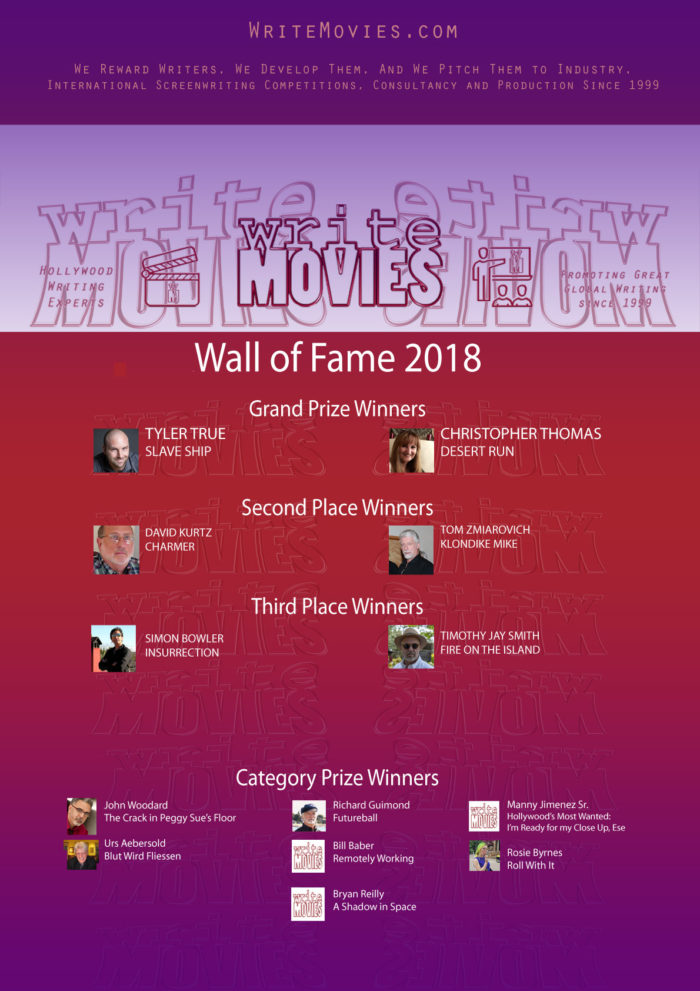
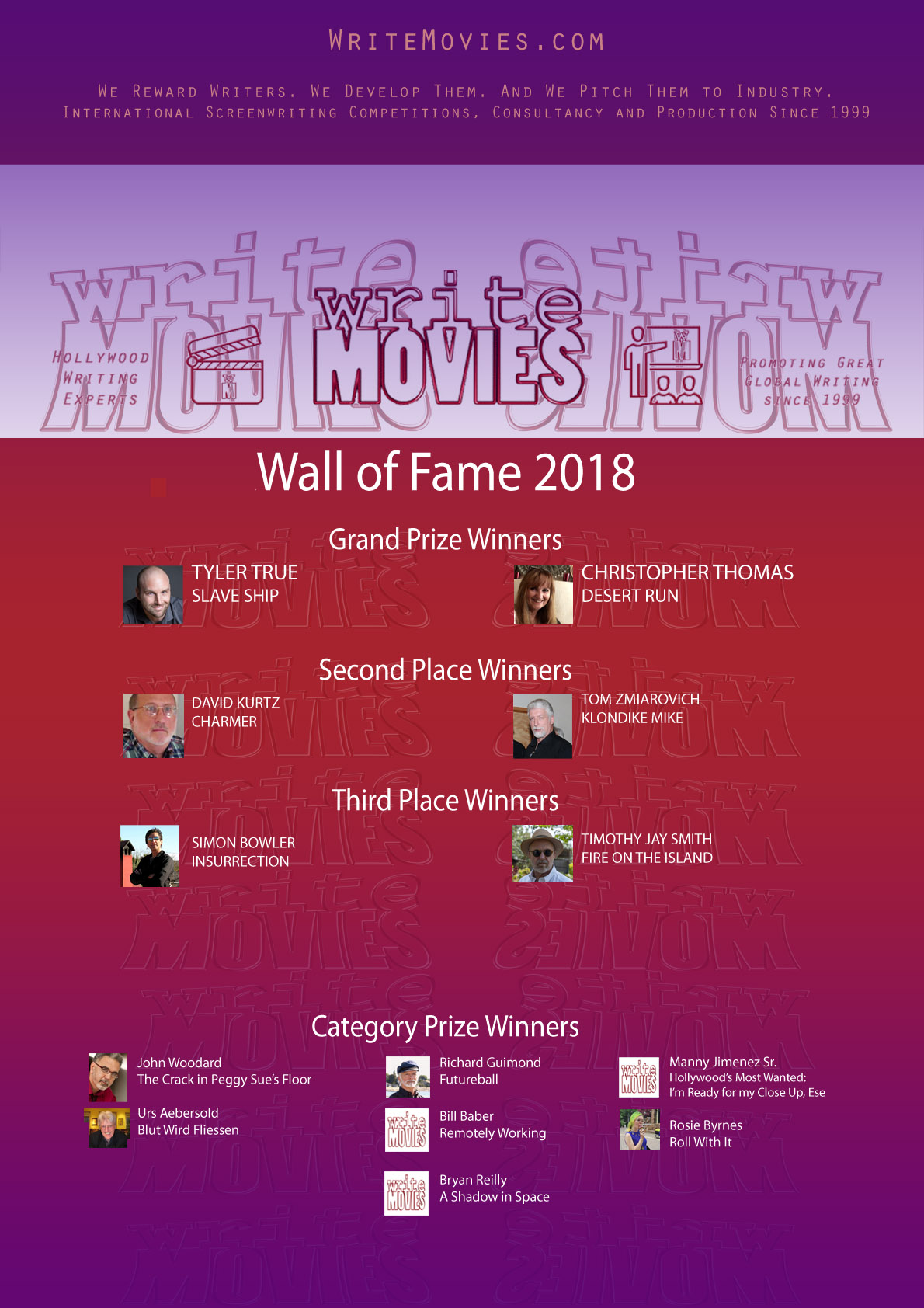
From the fierce competition of our most recent contest, one script emerged victorious. We are proud to introduce the WriteMovies Spring 2018 Contest Winner: DESERT RUN by Christopher Thomas!
A wartime action-adventure script set in Egypt, 1942, DESERT RUN is a thrilling script that rejuvenates the classic era of adventure. Full of excitement and romance, it kept us on the edge of our seats from the first page to the last, and deservedly took the top spot in our contest. Chris wins a cash prize of $2000, a year of script development worth up to $3200, and more!
Here’s a summary of the WriteMovies Spring 2018 Contest winner…
Michael Quinn, a man haunted by memories of a war-scarred childhood, grows into the roughshod desert explorer who discovers the enormous oil reserves in Saudi Arabia. By 1942, his company is the most important source of oil in the world – a world that craves his product – a world at war.
As Quinn tries to keep the oilfields out of Hitler’s hands, he discovers that the lives of a young nun and her crew of streetwise orphans are pawns in a deadly deal. And as the Nazis brutalize North Africa, Quinn and the boys devise their escape.
With Nazis at their back and the Sahara desert before them, a monster sandstorm offers them refuge. It’s said that the desert takes care of its own but the price is high, and when the survivors are finally confronted with a real hell-on-earth, they find their bonds irrevocably forged and their mettle tested.
And a short bio of Chris…
As a little girl growing up in Saudi Arabia, I was aware that I was surrounded by stories of epic proportions. History was happening everywhere and it gave me a particularly urgent perspective on humans, their conditions and their resilience that continues to feed my screenwriting. When I’m not mired in some dark and dire world I’ve created, I’m a creative writing instructor and a writer/designer of educational material based in Santa Fe, New Mexico. I’m also the Director and Lead Instructor for the Boulder Writing Studio’s Summer Creative Writing Camp series in Boulder, Colorado and serve on the Board of Directors. Prior to that I spent over 20 years as a senior level creative in the fields of animation, broadcast advertising, media design and film/video production. I have an MA in Educational Design E-learning from the University of Colorado Denver.
Want to follow Chris and become a Grand Prize Winner? Our Winter 2019 contest is now open – final deadline January 2019! Enter today and take your first steps towards writing success with WriteMovies!